Saturday, July 3, 2021

ANOTHER DAY IN SANTA ROSA


This was actually almost a week ago and I was at the Children's Museum in Santa Rosa with the Blum family.   It has great outdoor and indoor exhibits and activities.  Max, Sally and I are relaxing in the picnic area while Roland and Violet have some free play time.

Here is a picture of Sally at the same spot:

Meanwhile, Violet was creating some percussion music:


Roland created enjoyed creative percussion, too:

There were lots of fun things to do inside.  I think our favorite was the Dentist office with a crocodile in the chair and you could use a device to see x-rays of his teeth.


Fun times with the Blums!

Sunday, June 27, 2021

SANTA ROSA, CALIFORNIA


Here I am at the Pride Mountain Winery which includes vineyards in both Sonoma and Napa counties and I am with some very special people.  In this photo are Roland Blum (age 9), Sally Johnson Blum, Violet Blum (almost 11), Max Blum, and me.  Max is holding their Boston Terroir pup, Biscuit. 

Here's the reason it is special.  In March 2020, right before the shutdown on travel, I got a message from Ancestry.com that I had a "100 percent parent/child match."  I quickly realized that the match must be with a baby boy that I put up for adoption in June, 1969.  Ancestry gives you a link to contact the person and so I did asking, "Are you the  baby boy I put up for adoption in 1969?"  He answered that "Yes, he was that boy."  Since then, we have gotten to know each other through emails and zoom calls and we also became Facebook friends.  Now that I am fully vaccinated and travel restrictions have eased, I made a trip to meet him and his family in person.  It is wonderful.  They are an amazing family.  Max is musical and artistic and a loving father.  Sally is friendly, a wonderful mom, and is the winemaker at Pride Mountain Winery, which is why we went there for the picture above.  Violet is loves art and animals.  Roland loves sports and active play.  They have a trampoline in the back yard which is good for hours of fun. 

We had a great day at the winery and I was honored to have a tour by winemaker Sally herself.  We went to the tasting room and a special banquet room.  I got to see Sally's office and meet her co-workers who were all very welcoming.  We toured the wine caves and I was astounded by how big they were.  Here's a photo of me and Max in the caves:


And here's another of me and Max in the caves with a barrel of Pride Mountain wine:


And here is a shot of Sally, Max and me in the wine cellar:

I learned that there are separate buildings for Sonoma and Napa wines because there are different regulations for each county.  Here is a photo of me with Max in the area between the two buildings:

I am standing on the county line and the caves are in the background.  We also went through the vineyards with Sally and she explained the layout and took us to the ruins of a winery that was burned during Prohibition.  Here is a shot of Max and me in front of a small portion of the vineyards:


It was a great day and I really enjoyed every moment.  We've also gone to Bodega Bay twice (once with my brother Jeff) and once to meet my friend Sheryl.  I don't have good pictures of either of those trips.  Other days we have spent in the neighborhood and getting Violet and Roland chances to do things they love---swimming, throwing footballs and baseballs, playing board games and just hanging out.   As I noted, a very special time.


Wednesday, March 17, 2021

Mont Saint Michel


Just for the fun of it, I've been trying several kinds of virtual trips.  I miss being able to actually travel. A few days ago, I "went" to Mont Saint Michel with Context Travels Conversations.   It was the first time I tried that service, so I went on my own to see what it was like.  The program was supposed to be 90 minutes and it went over that, but it was OK because lots of useful information came up during the question and answer time.  The tour guide was Alexander Wilson.

The historical background was great.  The idea for a structure on the site began with Aubert the Bishop of Avronches in AD 708.  According to texts that have been preserved, he was visited three times in his dreams by the Archangel Michael who told him to build an oratory, or chapel.  He ignored the first two commands, but the Archangel poked a hole in his head the third time and so the Bishop obeyed. 

I won't go into all the details Mr. Wilson shared with us (about 65 participants by zoom) but, as the church became a pilgramage site, there was a need for a bigger structure.  The island is small, however, and very steep.  The solution was to build a sort of platform with the church on top.  It ended up as a three-storey structure, with common people using the lower floor, aristocrats on the middle floor, and the clergy on the top floor.  I think this was about the thirteenth century. 

During the French Revolution,  the monks were chased out and Mont Saint Michel became a prison.  The prison closed in 1863 and restoration didn't begin until 1874.  It was a huge project and restoration and research continues to this day.

Mr. Wilson took us through the main rooms of the cathedral as they are today.  My notes about that are not very good.  It is beautiful and I think I was taking in the visuals.  He then took us through the ramparts and village on the island.  He said very few people actually live there, though there are small inns and places to stay and many restaurants, including the most well-known;  La Mere Poularde where omelets are served. 

It was interesting, and worth the time and money, which is about $36 US dollars.  I think I like the longer, more intense virtual "trips" I've taken with Road Scholars.


Friday, March 12, 2021

Washington State Wine from Women Makers


Louisa, Chantel and I did another wine-tasting through Smithsonian Associates a week ago (March 5).  It was led by Eric Siegelbaum, who calls himself "SOMLYAY" and who also led the Northern California tasting last month.  This time, he focussed on women wine-makers in Washington State.  It was interesting to learn that the wine-growing region is very dry and dependent on irrigation.  The photo above shows the dry hills in the background of the vineyards.  Oh, I can't help mentioning that Eric had a great t-shirt "HERE FOR ALL THE RIGHT REISLINGS."

We again got the tasting wines in little bottles from Eastern Wine Bar, blocks from our houses, and  associated with Schneider's of Capitol Hill.  The wines were:

1. Sparkman Cellars "Birdie" Reisling, a Columbia Valley wine.  The winemaker is co-owner of the vineyards, Kelly Sparkman.  The grapes were ground by Lacy Lieback who grows over 21 varieties.  It arguably the best reisling I've tasted.  I usually avoid reisling because I think they are too sweet, but learned that there are dry reislings.

2.  Brook and Bull Cellars Chardonnay, also a Columbia Valley wine.  Ashley Trout is the winemaker.  I don't have further notes, but liked the wine.  I always like a chardonnay.

3.  Chateau St. Michelle, Cold Creek Vineyard, Cabernet Saugvignon also a Columbia Valley wine.  The winemaker is Leah Adint.  She has an interesting history and did graduate work in Austria.  I think this was an outstanding wine, very rich and robust.

4. Baer Winery "Ursa"  Another Columbia Valley wine.  Lisa Baer is the winemaker and Erica Orr is the consulting winemaker.   This wine is a blend of Merlot and  Cabernet Franc with Cabernet Sauvignon and Malbec.  It was delicious.

5.  Cote Bonneville, Dubrul Vineyard Syrah.  This wine is from the Yakima Valley.  Kerry Shields is the winemaker and Kathy Shields is a co-owner.  The vineyard has been recognized as the best in Washington State.  This wine was rich and tasty.

6. Buty, "Rediviva of the Stones" is from the Walla Walla Valley: specifically, an area known as the "Rocks District of Milton-Freewater.  Nina Buty is the owner,  I have no more notes.  I'd had six glasses of wine by then.

It was fun.  Louisa and Chantel were at Louisa's house, but I was at mine.  I think Peter took a few sips, too, as he reported the Baer Winery wine was his favorite.  

Saturday, February 6, 2021

Wines of Northern California: A Top Sommelier's Guide


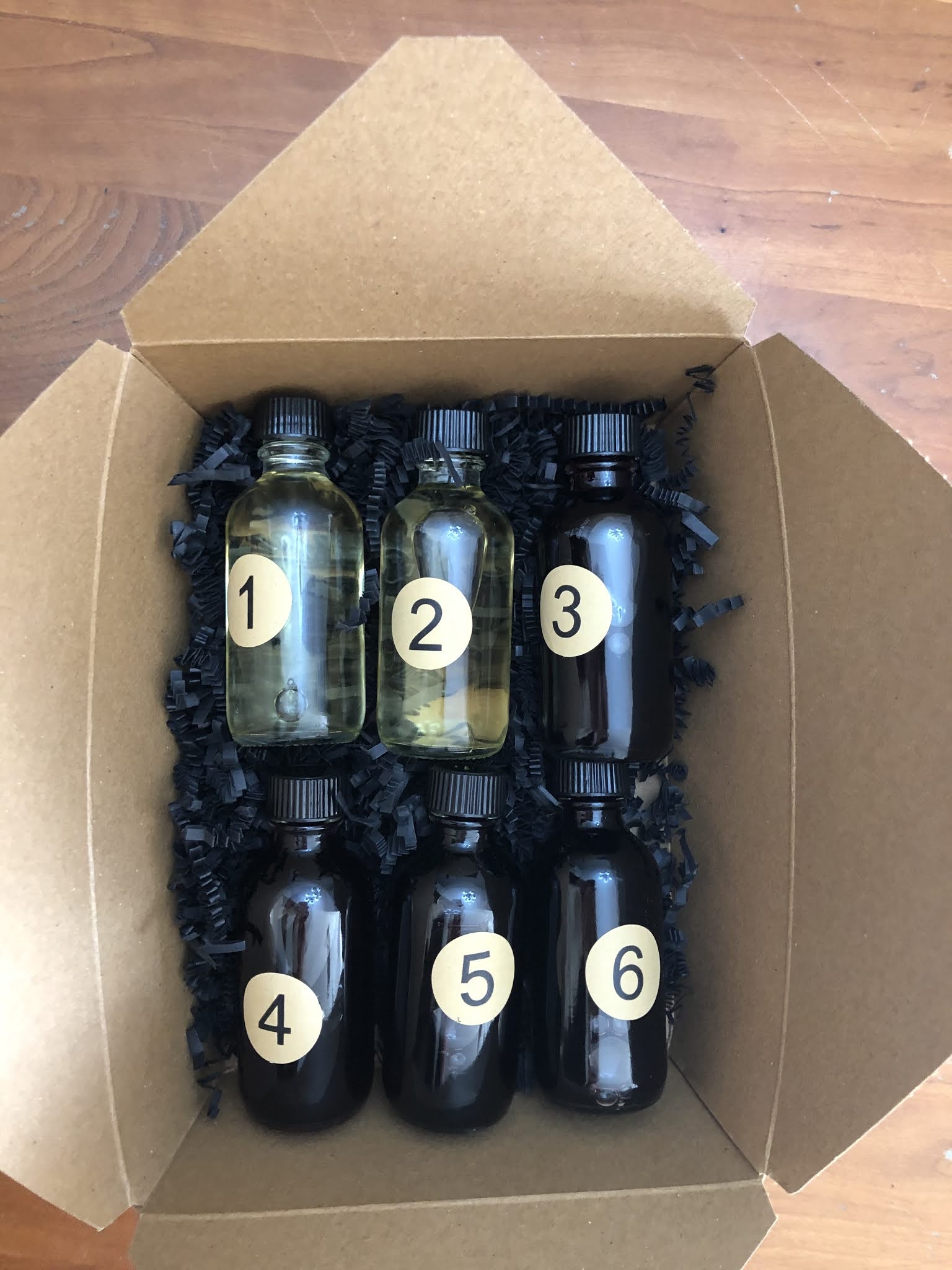
Last night I went to a Northern California wine tasting.  Oh, alright, it was a virtual trip through Smithsonian Associates.  The day before Louisa picked up the tasting kits, shown above, from a local wine bar.  The six wines we tasted were:

1.  Bee Hunter Semillion from Yorkville Highlands 2017
2.  Ancient Oak Cellars Chardonnay from Russian River Valley 2017
3.  Paul Hobbs "Crossbarn" Pinot Noir Sonoma Coast 2018
4.  Bee Hunter GSM (50% Grenache/25% Syrah/25% Mourverde) Sonoma County 2015
5.  Far Niente "Post & Beam" Cabernet Sauvignon Napa Valley 2018
6.  Ancient Oak Cellars "Pagnano Vineyard" Zinfandel Russian River Valley 2016

It was so much fun because the SOMLYAY (that's how he spells it) Erk Segelbaum really knows wine and has a fun presentation style.  He talked about elevation and how that affects the grapes, why the fog is part of the process for some of the wines, and much more including the impact of prohibition on the wineries and the role Robert Mondavi played in California wine marketing.  It was a memorable experience.  Louisa and Chantel both also "went" to the tasting.

Of course, it made me a little homesick for Northern California as many of the places were familiar to me.  These wines weren't, though, so it was a pleasure to learn something new.

Friday, January 29, 2021

SIENA!!!!


Yes, THAT Siena.  The one in Italy!  I recently went there (virtually) with Smithsonian Associates.  Louisa went with me.  We were only there a little over an hour, but it was a wonderful escape.  The tour guide, Elaine Ruffolo, knows a lot about Italian history and so we learned a lot.

Siena was an Etruscan village and not too important until about 1000 AD.  At that time, innovations in farming included how plows were used and oxen were yoked and those improvements led to agricultural surpluses.  Those surpluses created opportunities for trade and for banking.  The banks were successful enough that they even minted their own coins.  It also was a stop on the famous pilgrimage trail Via Francigena going to Rome so there was commerce related to those travelers.   

As Siena flourished, so did Florence and a rivalry developed between the two cities.  Siena was aligned at that time with the Holy Roman Empire and Florence was then aligned with the Papal State.  In 1260, there was a famous battle, Montaparte, between the two cities.  Going into that battle, the citizens of Siena appealed to the Virgin Mary for support and left keys to the city on the altar of the church for her.  They were at a disadvantage, but they won.  According to our guide, citizens of the two cities still bristle at that rivalry today.  The people of Sienna credited the Mary for their success and built a beautiful church in her honor, as shown in the photo above.   The tower was built a little later and is very distinctive as it is striped in black and white, which are the colors of the Siena flag:

The colors of black and white date back to the legend that Siena was founded by two brothers who were sons of Remus (of the Remus and Romulus who are purported to have founded Rome).  Part of the legend is that one brother rode in on a black horse and the other rode in on a white one.  

Another important and interesting building in Siena is the Palazzo Publico which was the seat of government.  I found it interesting that nine "good" men were selected by a drawing to serve two-month terms and were locked in during those terms.  There is a very elaborate work of art in the Palazzo showing an allegory of good and bad management.  Ms. Ruffolo had some good pictures of it, but I couldn't find any.  It is just interesting that they received such "guidance."

The Bubonic Plague was devasating for Siena and they lost 40% of their population.  Their commerce had been limited to banking, agriculture and support for pilgrims and was not very diverse.  Florence, in comparison, had a broader base to their economy and so had a stronger recovery/  

We also saw some film footage of the famous horse race, The Palio, which is a big attraction in Siena.  It is in July and August and both races were cancelled in 2020 due to the pandemic.  I went on-line and saw that it is scheduled for July 2, 2021.  
 
In a week, Louisa and I will take the companion trip to Florence with the same tour guide.  I have actually been physically in Florence, though it was several years ago.  I had never been to Siena, but now I hope to actually travel there. 


Saturday, December 5, 2020

VIRTUAL PARIS DAY THREE


The theme of the third day of the Road Scholar virtual trip covered Paris and the Revolutions.   My notes are not good, but I will forge on with this.  It seems like it was a pretty chaotic time.

Our guide Nettah described the circumstances leading to Bastille Day, July 14, 1789.  A major issue was that France was on the verge of bankruptcy, partly due to financial support for America.  The French supported us against Great Britain in the American Revolution.  Another major issue involved the Three Estates--the nobility (First Estate), the clergy (Second Estate) and everyone else (Third Estate).  The Third Estate was 98% of the country., but only 1/3 of the power.   Representatives of the three estates met at the Palace of Versailles.  The King was Louis XVI.  

At Versailles on May 28 1789 the Third Estate began meeting separately, as the Communes.  They declared they were a National Assembly, and would not be under the monarchy's supervision. That caused King Louis XVI to shut down the hall in which they were meeting, so they began meeting in June 1789 at an indoor tennis court at Versailles.  They vowed to work toward a new constitution.  The picture above is a depiction of how it might have looked at the tennis court.  I am not clear of the connection, but the storming of the Bastille took place in July and Louis XVI was forced to recognize the National Assembly.  In August, the Assembly met and voted to abolish aristocratic privileges.  The National Assembly continued to work toward their revolutionary goals and seized church property in November.  

The King and his family attempted to flee to Varennes in June 1791 but they were caught.  He was tried by the National Convention and found guilty of high treason.  He was executed by guillotine on January 21, 1793.  Shortly after that, his wife, Marie Antoinette was also tried and also was guillotined.  Her spending had been one of the things that led the revolutionaries to revolt.

Robespierre was elected President of the Convention and presided over what is known as the Reign of Terror because there were many massacres and executions during that time.  It was portrayed as an attempt of republican government under his leadership, but people turned against him and he was beheaded in 1794.  

I am not sure, but it seems that there was a relatively peaceful time for a few years.  But Napoleon Bonaparte who staged a coup in November 1799.  He became more and more powerful and was crowned as Emperor in 1804.  He led France to become the dominant land power of Europe, while Britain dominated the seas.  He lead an army of 700,000 to invade Russia but had to retreat because of winter weather.  He was defeated in 1814 by a coalition of Russian, Austrian and Prussian forces and exiled to Elba but he took power back about a year later when he escaped and returned to Paris.  The French people welcomed him back and the King, Louis XVIII fled to Belgium.  A European coalition defeated him at Waterloo and he was again exiled; this time, to St Helena where he died.  He may have been poisoned.  

Louis XVIII was restored as King in July 1815

I am not going to post the next two days to this blog.  My notes are not that good, and I think it is enough to say it was worthwhile and fun for Louisa and I to do together.  


Tuesday, December 1, 2020

PARIS DAY TWO


On day two, we covered the Renaissance in Paris and the Age of Reason.  The most interesting thing I learned from this period is how the Mona Lisa ended up in France rather than in Italy.  King Francois I invited Leonardo da Vinci to France in 1516 and Da Vinci brought the Mona Lisa with him perhaps as a gift to the King.  When Da Vinci died in 1519, the painting remained in France, as part of the various kings' art collection (including Napoleon) and was eventually hung in the Louvre in 1804.  It was stolen in 1911 by an Italian living in Paris who returned it to Italy a couple of years later.  Although he claimed it was a patriotic act, he was caught when he tried to sell it.  It was returned to France.

The ideas that defined the Renaissance were proportionality, order, harmony, humanism and classicism.  Da Vinci's work is an example, especially the Vetruvian Man.  


As you can tell, I am a huge fan of DaVinci.  When I was in Paris and able to go into the Louvre in person,  I made a point of seeing the Mona Lisa.  I often say it was one of the most horrible experiences of my life.  Too crowded and it's so small!  Plus, tourists crowd around to take selfies with it even though it is under two pieces of bulletproof glass.  Seeing it virtually is actually better. 

The Enlightenment, or Les Lumieres, was also dominated by order and reason.  It was interesting to learn that the first coffee house, Le Cafe de Procope, was opened in 1686.  Coffee houses were places where men could talk about their ideas.  It is also rumored that the idea for an encyclopedia started at Le Cafe de Procope.  

We also took a virtual "field trip" to the Sorbonne and the College de France on the Left Bank where students could study and it wasn't tied to certificates or degrees or anything like that....just for learning.

Saturday, November 28, 2020

PARIS!!!!!


Recently (November 16-20) Louisa and I went to Paris.  Well, of course it was virtual....but it was great fun and very Parisian.  We did it through Road Scholar with Nettah Yoeli-Remmer as our guide.  It was very different from actually being there, but we could do things in historical sequence instead of geographical so it made a lot of sense.  We missed stopping for pastries, though...and sketching in the streets of Paris or by the Eiffel Tower.  When we were actually in Paris a few years ago so we revisited some good memories.

We covered a lot and Nettah had a variety of slide decks, videos, handouts (we got by email) and his own rich knowledge.  He made the virtual experience seem very relevant.

Day 1 covered origins of Paris, Ile de la Cite, Sainte-Chappelle and Notre Dame.  The first thing we learned was that the name Paris does not come from the Greek god Paris, but instead from a Gaul tribe, the Parisii who were brought under Roman control in 52 BC.   We saw pictures of a Roman arena (part  of Arenes de Lutece and built in the first century AD), which is still in Paris and can be visited once travel resumes.  I had no idea it was there and that is one of the interesting revelations of this virtual tour.

Christianity came to the city in the 3rd Century and Saint Denis became the first Bishop.  He was eventually decapitated and the picture above is of a statue at the Notre Dame that shows him carrying his own head.  The story is that he continued his sermons carrying his head after the decapitation and that is why he became a Saint.

Germanic tribes sacked Paris in 270 AD and so it became under Frankish rule.  Clovis I became ruler in 481 AD at the age of 16 when his father died.  He united the Frankish tribes throughout the region.  He increased his authority with Rome by marrying a Christian wife and then he himself converted to Catholicism in 496 AD.  He became the first Bishop of Paris. 

We  went to Notre Dame (through a video narrated by Nettah) and saw pictures of it post fire.  A decision has been made to rebuild it as it was at the time of the fire.  Nettah led a great discussion of it as classic Gothic architecture (construction began in AD 1163) and how the flying buttresses stabilize the walls and allow for open spaces in the interior.  

We "toured" another church that is physically nearby--Sainte-Chapelle.  Sainte Chappelle is not a cathedral and was privately built by King Louis IX as a chapel and a place for relics he had acquired, such as the purported crown of thorns worn by Jesus and a fragment of the cross.  By the way, these relics were transferred to Notre Dame a few years ago and were saved from the 2019 fire at Notre Dame.  Louisa and I visited Sainte-Chappelle when we were in Paris a few years ago.  It is amazing with soaring panels of stained glass.  It was built in the 13th century.  This picture doesn't do it justice.  


There was more, but this is pretty long already for a blog post.  This was only day one of five, so I hope to do four more.

Wednesday, May 27, 2020

Revolutionary Love Fourth Installment


I am still writing about the second day of the virtual conference.  There were breaks built in for meditation and for dancing. I didn't think too much of the dancing ones, and used them as breaks from the program.  I loved the meditation, though, which was led by Anu Gupta.  He led meditation as a way to develop empathy and compassion for all beings.  One of the things he said as he started the first meditation was that breath has been with us from birth.  I had never thought of it that way.  The guided meditation asked participants to focus on someone for whom you have unconditional love--a beloved.  Imagine smiling at that person and having them smile back at you.  Then greet that person with what I will call a mantra;
  • May you be happy and healthy
  • May you be safe and protected
  • May you be in peace
  • May you live with ease
Anu then asked us to reflect on our five-year-old selves in the same way with the same mantra..
The next part was to reflect on those attending and then extending this to all beings.

It was very good for me, and Anu said he teaches it to help break bias.  He pointed out that bias is learned.  The picture above is how I like to imagine myself when meditating.  

Monday, May 18, 2020

Revolutionary Love conference - third installment


Although this is the third installment, I am still writing about the second day and I have decided that I can only deal with highlights.

Edgar Villanueva, who was paired with Barry Segal, talked about the power of money.  Segal is a philanthropist, but wasn't that interesting to me.  His talk was pretty traditional.   Villanueva is an indigenous person working in philanthropy and has written a book called Decolonizing Wealth.   He didn't say how he got involved with philanthropy, so I am not sure.  He did talk about his very modest childhood and how he grew up as the son of a single mother who worked three shifts.  She worked at the Department of Motor Vehicles and then 2 shifts working in people's homes as a nursing assistant.  Villanueva would tagged along and so got to go into fancy homes.  On Saturdays and Sundays, his mother worked on outreach for the church and made sure kids got to church on the bus.  She would say that helping kids was her "medicine.  He also talked about, when indigenous people want to get to know you, they ask "who are your people?"  In other words, who do you associate with...not just who you are.  Another idea he put forth was that money is not the root of all evil, it is the love of money that is the root of all evil.  As we have seen in these coronavirus times, some people do value money more than human life.  He explained why he talks about decolonization.  According to his thinking, when societies conquer civilizations, they take resources and leave.  However, when they colonize, they stay and exploit the society.  He put forth the premise that wealth in America today was built through colonialism.  To him, decolonization means that which has been stolen is returned.  There was a lot and some pretty radical ideas, in my view.  But he definitely gave me something to think about.

Another impressive speaker on day 2 was Rabbi Michael Lerner.  His book (it seems like they all have a book) is actually called Revolutionary Love.    He portrayed Revolutionary Love as love for everyone and acceptance that we are interdependent.  It is a little complicated, but he proposes that the capitalism we have come to accept and that we are told is "efficient, rational and productive" is not.  To him, a culture that is "efficient, radical and productive" would actually be based on love and caring.  For those who think this is a great idea, but unrealistic, he has encouraging words.  Major social changes have resulted from people who were told their ideas were unrealistic but persisted.  He had harsh words for the liberals and progressives who portray themselves as being on a higher level than others..  What we need, he says, is REAL caring for people who seek meaning and purpose in their lives.  He says selfishness is learned and is not human nature.  There was more, but these were the highlights for me.  I guess you can see why I found him an inspiring voice.

Monday, May 11, 2020

Revolutionary Love Conference Installment 2


On the second day of the conference, Rob Hardies, the Senior Minister of  All Souls Church, gave a talk that was about voting rights and some history of why All Souls is so committed to this issue.  A former Associate Minister, James Reeb (pictured above), was killed in Selma Alabama in 1965.  He was demonstrating for voting rights for African Americans.  After eating at an integrated restaurant, he was killed by four white men.  Reeb was one of many who have died or were injured fighting for voting rights and yet, today, many (especially minorities) are still denied the right to vote.  We have work to do so that everyone has a vote.

Another highlight of the day was hearing Linda Sansour whose talk was titled "No Time for Bystanders."  If you don't know who she is, she is credited as the co-founder of the 2017 Women's March the day after Trump's inauguration.  The title of her talk was apt--she presented reasons to act for love-driven justice.   She gave several concrete suggestions of what we can do now:
  • Write notes to neighbors, saying I am here for you and what can I do to help?
  • Volunteer at a food bank or help in deliveries
  •  Insist on quality health care for all that is not connected to employment 
  • Insist that essential workers get personal protective equipment and a living wage, including hazard pay
  • Support the US postal service because small business depends on it, we need the option to vote by mail and many of us just need it.  One way is to buy stamps and send letters.
  • Tell your representative that the next stimulus package needs accountability, must get money to marginalized populations
Some of these will work better for some people than for others, but I welcomed at least hearing them.  Even though I am in DC, I don't have much influence on the national scale.  Our Representative doesn't have a vote--she is called a "Delegate."  She has an office and is on committees, but that is it.

That's enough for this post.  I have more about the second day, but will post it separately.  I just can't possibly cover it all.

Friday, May 8, 2020

Revolutionary Love conference, overview and "Preamble"

Revolutionary Love 2020

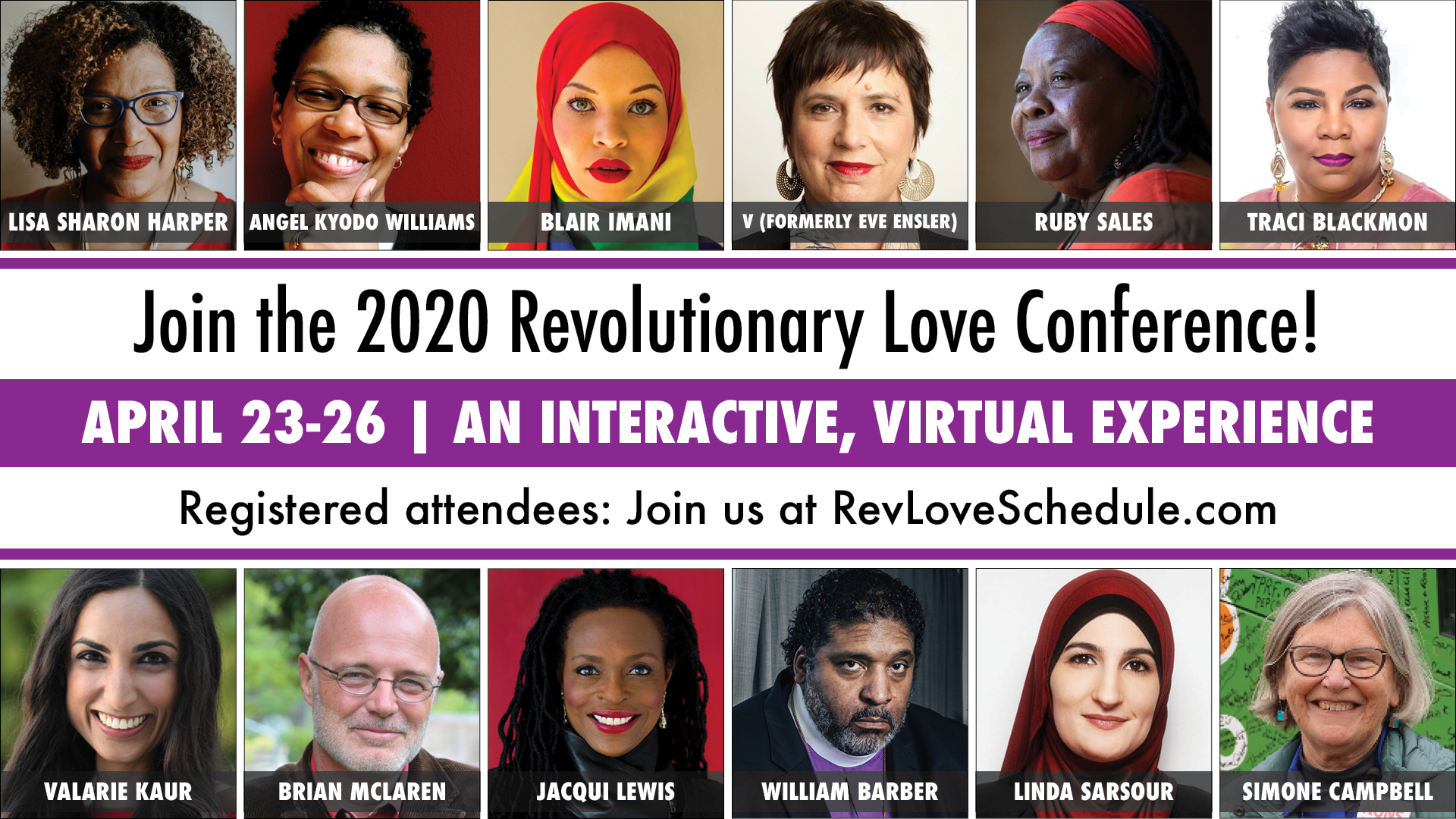
I recently "went" to a conference called Revolutionary Love.  It was mostly done by "Zoom," though there were a couple of youtube sessions.  The original plan was to have it in Washington DC at All Souls Church (my church), but it was moved on-line because of social distancing in the time of coronavirus.  Middle Collegiate Church in New York City was the organizing congregation, and Jacqui Lewis, minister at Middle College Church was the conference leader.

I'm not sure how to describe it.  It was a call to action to "form a more perfect union;" one that is more inclusive than the framers of the Constitution envisioned.  After all, the "We, the people" at that time did not include indigenous peoples, enslaved Africans, women, poor people, or those who had no land ownership.  We, the people, at that time were the white landowners.

This was a very intense experience and involved about 25 hours over four days.  It was broken into general sessions, breakout groups, workshops, and some meditation and exercise sessions.  I will share parts of it that were meaningful to me and it will be several blog posts.

The " Preamble" on Thursday night was a discussion including Charles Randolph White; Cornelius Smith, Jr.; and Kenneth B.Morris, Jr.  White is a director who will be presenting a play about Frederick Douglass at the Arena Stage here in Washington DC. when we can go to the theater again.  Smith is an actor (he was in Scandal) who will play Douglass in the play and Morris is a descendant of Douglass and Booker T. Washington.  They talked about Douglass, of course.  I was particularly impressed with a quote from what is called the Fourth of July speech by Douglass and was actually delivered on the Fifth of July, "It is not light that we need, but fire."  I've always been inspired by Frederick Douglass and this stoked that inspiration.  Smith also did that quote as a song.

There was also a powerful presentation by Kaitlin Curtice, a Potawatomi Native American and a Christian.   The evening closed with Tituss Burgess (of The Unsinkable Kimmy Schmidt) singing "Count Your Blessings" and discussing the topic of "Revolutionary Love" with Jacqui Lewis.   They also sang a few songs together, including "I Need You to Survive" which resonates with me right now.


Saturday, June 8, 2019

May 12---last day in Rome


I began once again by boarding the #64 bus and going to Termini because I wanted to visit the Baths of Diocletian.  The most interesting part, to me, was the church designed by Michelangelo that had been part of the baths.  Today, it is very elaborate, as shown above.  I was there on a Sunday morning so, after a little exploring, I went to the Mass.  It was excellent, and I was glad I sat down a little early as "visitors" were held at the door and not seated in the pews, as I was.  I actually sat next to one of the most interesting features of the church, La Meridiana.  It was laid out in 1702 and points due north.  It acts as a sundial and is also a calendar.  A little ray of sun comes in through a hole cut high in the wall. It was overcast when I was there, so I didn't get to see it as it functions.  Here is a picture of a portion of it:
It is completely roped off as they don't want people walking on it.

After the Mass, I went to another church where I saw a famous Bernini statue showing Saint Teresa in ecstasy.  On a sunny day, the light shines in and illuminates her.  There is a quote printed out that explains Bernini's inspiration.  In that quote, Saint Teresa describes how she was pierced by an angel.  It is all very dramatic.  She felt pain and also ecstasy. I didn't take this picture. It wasn't that well-lit for me, but it is a beautiful statue and I could feel the emotion,
I then walked down the Via XX Septiembre laid out in 1870 to commemorate Italian nationalism.  I saw the Fountain of Moses which was quite dirty.  I didn't take a picture.  I then reached an intersection where there are four fountains.  It was pretty interesting.  I had expected a fountain in the center, but there were four fountains on building surrounding the intersection.  This is one of them:

This one is the goddess Juno.  

I continued on to the Palazzo del Quirinale which is the residence of the President of Italy.  It was open and tourable---but I didn't have reservations!  So I hung out for awhile in the Piazza del Quirinale which was great.  Here's a photo:
I then wound my way back to my favorite restaurant.  It was still pretty early, but Italians eat lunch late....particularly on the weekends.  I didn't write the name of it down, but I had polenta with meat sauce and it was amazing.  I was sitting outside and it started to rain and then hail, so I moved inside.  I had pretty much finished the polenta, but had a little more wine.  I left there and went to throw a coin into the Trevi Fountain since it was my last day in Rome.  It was still raining, but I threw in a euro.   I wandered back and (I love this) my polenta bowl was still on the table.  So Italian--why go out in the rain to clean up?  Just do it when the rain really stops.

I hopped back onto the #64 bus to go to my apartment.  It was very crowded!!!  Sad to say, I think that is when I lost my phone...or it was stolen.  We had been advised to be careful of pickpockets on that bus, so I guess it should have been expected...but it wasn't.  I had planned on taking uber to the airport, but you can't do that without a phone.  I remembered seeing a taxi stand near my apartment, so that is how I got to the airport the next morning and headed for home.

It was a great trip!!!

Tuesday, June 4, 2019

May 11--Pilgrim's Rome---three churches

Church of Santa Prassede


This is the church I wanted to see a couple of days ago, but it was closed.  I was glad I went back.  The exterior, shown above, was not particularly impressive.  But inside---WOW!  It was originally built in 522 AD, and had been remodeled during the Renaissance and Baroque periods.  What impressed me the most was the mosaics.  They show the Byzantine influence and are similar to those I had seen in Ravenna. I didn't get good pictures and couldn't find ones on the internet that would work.

Another important feature in this church is the Chapel of St. Zeno.  It is only illuminated when you put in a euro.  I had brought euros because I had read about it before arriving, but I still couldn't get a picture. I found this one on-line of the ceiling:

The chapel was small, but impressive and absolutely covered in mosaics.  It also has a relic that is purported to be fragments of a pillar that was used to flagellate Jesus.  Whether one believes that or not, this was a place of peace and serenity..

Church of San Giovanni in Laterno
The next church I went to was the first Christian church in Rome, opened in about 318 AD.  It was the home church of the popes and, until 1870, the popes were crowned here.  There is still a chair that a Pope sits in after election.  For example, Pope Francis sat there on April 7, 2013.


It is a huge church with a statue of Constantine on the portico.  I think that may be original, but not much of the church is now.  It has been remodeled many times.  The ceiling is from the Renaissance.  Statues of the apostles stepping out "to spread the word" are from the Baroque period, as is most of the interior.

It is pretty impressive and the "in Laterno" designation means that it was the seat of the Pope and the original cathedral of Rome.

Oh, I forgot to mention the "holy stairs."  They are near San Giovanni in Laterno and are said to be stairs that Jesus climbed on the day he died.  They were brought to Rome by Emperor Constantine's mother.  They were behind a locked gate when I saw them.  I hadn't planned on going up them anyway as you are supposed to go on your knees and say a prayer at each step.

Basilica of San Clemente
This was by far the most interesting of the churches I saw on this day.  It is a 12th century church built on top of a 5th century church built on top of a pagan temple.  The apse of the church is a mosaic with lots of gold.  Jesus is shown on the cross with the apostles as doves, the circular designs symbolize a Tree of Life, and there are animals and saints.

Another interesting art piece is in a chapel called the Chapel of St. Catherine.  It has frescoes all over it, including one by Masolino showing space perspective and telling a story of the martyred St. Catherine:
These perspectives were innovative at the time.  This blog is too long for me to elaborate on the story that is told.

Going down to the lower church from the fourth century, I saw more frescoes:

What is left of the fourth century church is modest, but beautiful:
And then I went to the Temple of Mithras:
This is another photo taken from the web.  It is a Mithraic temple. The pillar in the center is a reproduction and shows Mithras fighting a bull.  The cult of Mithras believed that he was responsible for bringing new life every Spring.  There were some other smaller rooms, but this is where the men (and it was only men) reclined and ate a ritual meal.  The ruins of this, and the fourth century church, were found by monks who were clearing out debris in the 19th century.   It is a real treasure.

Saturday, June 1, 2019

May 10--Museo dei Fori Imperiali, Mortali/Immortali, Trajan

It was great to be part of a Road Scholar tour, but (by necessity) there were things I wanted to see that weren't included.  That is why I took a second week on my own.  I went to the Museo dei Foro Imperiali, which I had passed many times because it was close to the hotel.  I can see why Road Scholars didn't include it.  The museum itself is not that impressive.  There are lots of fragments of statues, columns, etc. and reconstructed statues.  The picture above is the upper interior with original arches.  It was part of Trajan's Forum.   There is a lot of natural light.  The lower floor has display rooms.  While I was there, there was a special exhibit titled "Mortali/Immortali."  It was a little confusing because it was about ancient Chinese treasures...which were not what I had come to see.

The truly spectacular thing is being able to walk out above Trajan's Market and Forum and take in some truly spectacular views....plus, it was a beautiful day.  Here's an example:

The Victor Emmanual Monument dominates the scene.  See that statue of a rider on a horse on the right?  I read that statue is so large that the moustache of the rider is five feet long.  But I was actually more interested in the remains of the Trajan's Market stalls in the foreground.  Trajan was Emporer 98-117 AD. In addition to the Market, there was a huge Forum.  I have to admit that I haven't taken the time to make distinctions of the various Fora---the Roman Forum, Caesar's Forum, and ones created by Augustus, Vespasian, Nerva, and this one by Trajan.
The above view interested me because it shows some of the excavation work going on now and also showcases some of the distinctive Italian pines.

In the view below, Trajan's Column is shown.  It was constructed during Trajan's reign and shows scenes of various military victories in a bas relief spiral going to the top.  It had a statue of Trajan at one time, but now the statue at the top is St. Peter.


Friday, May 31, 2019

May 9 Santa Maria Maggiore


I decided I needed to see more churches and started out using Rick Steves' "Pilgrim's Rome" as a guide.  Once again I boarded the #64 bus to Termini and then I walked from there.  It was a little longer walk than I anticipated but through a beautiful neighborhood.  The photo above is of the main altar.  This is an old church (432 AD) and has amazing mosaics that reminded me of mosaics I had seen in Ravenna.  It was, of course, updated during the Renaissance and Baroque periods.  The ceiling is coffered and gilded, and this only shows part of it.


When you go up to the main altar, you see that there are stairs to something below.  I went there and was treated to what is purported to be relics of the manger in Bethlehem:

It is hard to connect the simplicity of Jesus' birth with this opulent display.  There is also a powerful statue of Pope Pius IX in prayer before these relics:
But look at those floors!  They are throughout the church, and may date back to the 5th century AD.

This church is truly amazing.  Below is an example of the mosaics that are throughout the main sanctuary.  This particular one is in the apse and shows Jesus crowning Mary in heaven:

When I left, I hoped to go to another church, the Church of Santa Pressede.  I had forgotten that many of the churches are closed between 12 noon and 4 pm.  It was closed.  I had lunch at a great little place with lots of locals and it was great.

I walked back to Via Nazionale and did some shopping and then took "my bus" back to my apartment.


Thursday, May 30, 2019

May 8--Palazzo Massimo alle Terme

Today I went to a different part of town.  My friend Karen Zens, who had lived in Rome several years, had recommended the National Museum of Rome.  It is near the train terminals (Termini), and the #64 bus goes there.  I also got to see what will be my shopping district, Via Nazionale, on the way.  This museum is actually several museums, but today I just went to the part housed in the Palazzo Massimo alle Terme, the building above.  I didn't take any photos, but did see a guy sketching.  That looked like fun, but I hadn't brought my sketching stuff.

There are a lot of statues and fragments of statues on the ground floor of the museum.  Of particular interest was a gallery of stone heads.  They seem to be ordinary people and I learned the Romans made them to remember their ancestors and the likenesses were more important than idealizing them.  They date to 500-1 B.C.   A bronze statue of "The Boxer at Rest" shows his face as scarred and his back muscles knotted.  It is very compelling. 
One of the most well-known works is "The Discus Thrower."  It is actually a Roman copy of a Greek statue.  


This museum had a special exhibit showing examples of how, in the 19th century, copying Greek and Roman statues became common.  In fact, the idea was that if a person went on a European tour it would be expected that they would bring back a copy of a famous statue. 

There was much more, but the second floor had frescoes and mosaics from Roman family villas.  The Villa Farnesina frescoes were especially compelling and show gardens with birds and fruit trees.  Lovely!

On the way back to my apartment, I stopped to check out some of the shops.  I will return because I have more tourist sights to see in the neighborhood and some more shopping to do, too.